Every set \(A\) is made up of its members. If \(a\) is a member of \(A\text{,}\) we write \(a \in A\text{,}\) and we use the symbol “\(\in\)” as the mathematical equivalent of the phrase “is a member of”. A set with no elements is called empty, and we denote the empty set by \(\{ \, \}\) or \(\varnothing\text{.}\)
If membership in a set is governed by a rule, we can use set-builder notation to describe the set. Set-builder notation is formatted
\begin{equation*}
\{ \text{ elements of } U \, | \, \text{ subject to this rule }\}.
\end{equation*}
For example, the set of even integers can be described by
\begin{equation*}
\{ n \text{ in the integers} \, | \, n = 2k \text{ for some integer } k \}.
\end{equation*}
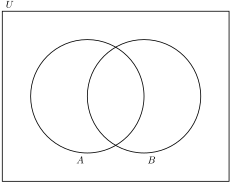
We think of sets as their own abstract objects, and typically we situate them within a larger universal set \(U\) in order to perform operations on sets. If \(B\) is another set, and if for every \(a \in A\) it follows that \(a \in B\text{,}\) then we say that \(A\) is a subset of \(B\text{,}\) and we write \(A \subseteq B\text{.}\) We also say \(A\) is a superset \(B\) in this scenario, and we can write \(A \supseteq B\text{.}\)
FigureB.0.1.Two sets \(A\) and \(B\) in a universal set \(U\text{.}\)
For example, \(\{1,2\}\) is a subset of \(\{1,2,3\}\) (i.e., \(\{1,2\} \subseteq \{1,2,3\}\)), but \(\{1,4\}\) is not (i.e., \(\{1,4\} \not \subseteq \{1,2,3\}\)). From this definition, it is clear that a set is a subset of itself. We say that the sets \(A\) and \(B\) are equal (and we write \(A = B\)) if and only if \(A \subseteq B\) and \(B \subseteq A\text{.}\)
Just as arithmetic features operations on numbers, set theory features operations on sets:
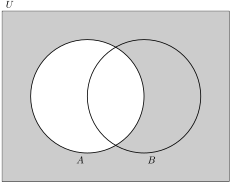
The complement of a set \(A\) is formed by the elements \(u \in U\) that are not members of \(A\text{.}\) For example, in the set of natural numbers,
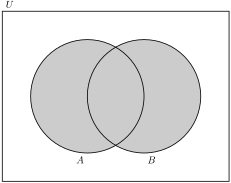
The union of the sets \(A\) and \(B\text{,}\) denoted \(A \cup B\text{,}\) is the set of all elements in \(U\) that are a member of \(A\text{,}\) or \(B\text{,}\) or both. For example, in the set of natural numbers,
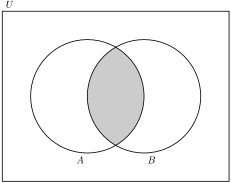
The intersection of the sets \(A\) and \(B\text{,}\) denoted \(A \cap B\text{,}\) is the set of all elements that are members of both \(A\) and \(B\text{.}\) For example, in the natural numbers,
FigureB.0.4.The intersection of \(A\) and \(B\text{.}\)
There are lots of other operations on sets (set difference, symmetric difference, Cartesian product, power set, disjoint union, complement, and more!), but to start, we only need to worry about complements, unions, and intersections.
TheoremB.0.5.
The laws for negations of conjunctions and disjunctions have natural counterparts for sets. Indeed,
\begin{equation*}
(A \cap B)^c = A^c \cup B^c
\end{equation*}
and
\begin{equation*}
(A \cup B)^c = A^c \cap B^c.
\end{equation*}
Furthermore,
\begin{equation*}
A \cap A^c = \varnothing
\end{equation*}
and
\begin{equation*}
A \cup A^c = U\text{.}
\end{equation*}
Some basic sets of central importance to us in linear algebra are:
the set of natural numbers, which we denote by \(\mathbb{N}\text{;}\)
the set of integers, which we denote by \(\mathbb{Z}\text{;}\)
the set of rational numbers, which we denote by \(\mathbb{Q}\text{;}\)
the set of real numbers, which we denote by \(\mathbb{R}\text{;}\)
the set of complex numbers, which we denote by \(\mathbb{C}\text{;}\)
the set of column vectors with \(d\) entries, which we denote \(\mathbb{R}^d\text{;}\) and
the set of \(m \times n \) matrices with real entries, which we denote by \(M_{m\times n}\text{.}\) When \(m = n\text{,}\) we write \(M_n\text{.}\)